ABOUT TRANSFORMER
A transformer is
an electrical device that transfers electrical energy between two or
more circuits through electromagnetic induction. A varying current in
one coil of the transformer produces a varying magnetic field, which in
turn induces a voltage in
a second coil. Power can be transferred between the two coils through
the magnetic field, without a metallic connection between the two
circuits. Faraday's law of induction discovered in 1831 described this
effect. Transformers are used to increase or decrease the alternating
voltages in electric power applications.
Since
the invention of the first constant-potential transformer in 1885,
transformers have become essential for the transmission, distribution,
and utilization of alternating current electrical energy. A wide range
of transformer designs is encountered in electronic and electric power
applications. Transformers range in size from RF transformers less than a
cubic centimeter in volume to units interconnecting the power
grid weighing hundreds of tons.
Windings


High-frequency
transformers operating in the tens to hundreds of kilohertz often have
windings made of braided Litz wire to minimize the skin-effect and
proximity effect losses.Large power transformers use multiple-stranded
conductors as well, since even at low power frequencies non-uniform
distribution of current would otherwise exist in high-current
windings.Each strand is individually insulated, and the strands are
arranged so that at certain points in the winding, or throughout the
whole winding, each portion occupies different relative positions in the
complete conductor. The transposition equalizes the current flowing in
each strand of the conductor, and reduces eddy current losses in the
winding itself. The stranded conductor is also more flexible than a
solid conductor of similar size, aiding manufacture.
The
windings of signal transformers minimize leakage inductance and stray
capacitance to improve high-frequency response. Coils are split into
sections, and those sections interleaved between the sections of the
other winding.
Power-frequency
transformers may have taps at intermediate points on the winding,
usually on the higher voltage winding side, for voltage adjustment. Taps
may be manually reconnected, or a manual or automatic switch may be
provided for changing taps. Automatic on-load tap changers are used in
electric power transmission or distribution, on equipment such as arc
furnace transformers, or for automatic voltage regulators for sensitive
loads. Audio-frequency transformers, used for the distribution of audio
to public address loudspeakers, have taps to allow adjustment of
impedance to each speaker. A center-tapped transformer is often used in
the output stage of an audio power amplifier in a push-pull circuit.
Modulation transformers in AM transmitters are very similar.
Dry-type
transformer winding insulation systems can be either of standard
open-wound 'dip-and-bake' construction or of higher quality designs that
include vacuum pressure impregnation (VPI), vacuum pressure
encapsulation (VPE), and cast coil encapsulation processes. In the VPI
process, a combination of heat, vacuum and pressure is used to
thoroughly seal, bind, and eliminate entrained air voids in the winding
polyester resin insulation coat layer, thus increasing resistance to
corona. VPE windings are similar to VPI windings but provide more
protection against environmental effects, such as from water, dirt or
corrosive ambients, by multiple dips including typically in terms of
final epoxy coat.
Regarding image at top captioned, Cut view of transformer windings:
- The conducting material used for the windings depends upon the application, but in all cases the individual turns must be electrically insulated from each other to ensure that the current travels throughout every turn. For small power and signal transformers, in which currents are low and the potential difference between adjacent turns is small, the coils are often wound from enamelled magnet wire, such as Formvar wire. Larger power transformers operating at high voltages may be wound with copper rectangular strip conductors insulated by oil-impregnated paper and blocks of pressboard.
- Legend
- White: Air, liquid or other insulating medium in conjunction with varnish, paper or other coil insulation.
- Green spiral: Grain oriented silicon steel.
- Black: Primary winding (Aluminum or copper).
- Red: Secondary winding (Aluminum or copper).
- Real transformer energy losses are dominated by winding resistance joule and core losses. Transformers' efficiency tends to improve with increasing transformer capacity. The efficiency of typical distribution transformers is between about 98 and 99 percent.As transformer losses vary with load, it is often useful to express these losses in terms of no-load loss, full-load loss, half-load loss, and so on. Hysteresis and eddy current losses are constant at all load levels and dominate overwhelmingly without load, while variable winding joule losses dominating increasingly as load increases. The no-load loss can be significant, so that even an idle transformer constitutes a drain on the electrical supply. Designing energy efficient transformers for lower loss requires a larger core, good-quality silicon steel, or even amorphous steel for the core and thicker wire, increasing initial cost. The choice of construction represents a trade-off between initial cost and operating cost.
Types
Various specific electrical application designs require a variety of transformer types. Although they all share the basic characteristic transformer principles, they are customize in construction or electrical properties for certain installation requirements or circuit conditions.- Autotransformer: Transformer in which part of the winding is common to both primary and secondary circuits, leading to increased efficiency, smaller size, and a higher degree of voltage regulation.
- Capacitor voltage transformer: Transformer in which capacitor divider is used to reduce high voltage before application to the primary winding.
- Distribution transformer, power transformer: International standards make a distinction in terms of distribution transformers being used to distribute energy from transmission lines and networks for local consumption and power transformers being used to transfer electric energy between the generator and distribution primary circuits.
- Phase angle regulating transformer: A specialised transformer used to control the flow of real power on three-phase electricity transmission networks.
- Scott-T transformer: Transformer used for phase transformation from three-phase to two-phase and vice versa.
- Polyphase transformer: Any transformer with more than one phase.
- Grounding transformer: Transformer used for grounding three-phase circuits to create a neutral in a three wire system, using a wye-delta transformer, or more commonly, a zigzag grounding winding.
- Leakage transformer: Transformer that has loosely coupled windings.
- Resonant transformer: Transformer that uses resonance to generate a high secondary voltage.
- Audio transformer: Transformer used in audio equipment.
- Output transformer: Transformer used to match the output of a valve amplifier to its load.
- Instrument transformer: Potential or current transformer used to accurately and safely represent voltage, current or phase position of high voltage or high power circuits.
- Pulse transformer: Specialized small-signal transformer used to transmit digital signaling while providing electrical isolation, commonly used in Ethernet computer networks as 10BASE-T, 100BASE-T and 1000BASE-T.
Ideal transformer
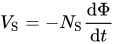
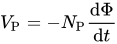
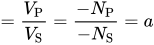
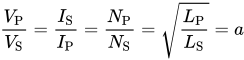
Ideal transformer equations (eq.)By Faraday's law of induction:. . . (1). . . (2)Combining ratio of (1) & (2)Turns ratio . . . (3) where- for step-down transformers, a > 1
- for step-up transformers, a < 1
By law of conservation of energy, apparent, real and reactive power are each conserved in the input and output. . . (4)Combining (3) & (4) with this endnote yields the ideal transformer identity. (5)By Ohm's law and ideal transformer identity. . . (6)Apparent load impedance Z'L (ZL referred to the primary).For simplification or approximation purposes, it is very common to analyze the transformer as an ideal transformer model as presented in the two images. An ideal transformer is a theoretical, linear transformer that is lossless and perfectly coupled; that is, there are no energy losses and flux is completely confined within the magnetic core. Perfect coupling implies infinitely high core magnetic permeability and winding inductances and zero net magnetomotive force.A varying current in the transformer's primary winding creates a varying magnetic flux in the transformer core and a varying magnetic field impinging on the secondary winding. This varying magnetic field at the secondary winding induces a varying EMF or voltage in the secondary winding due to electromagnetic induction. The primary and secondary windings are wrapped around a core of infinitely high magnetic permeability so that all of the magnetic flux passes through both the primary and secondary windings. With a voltage source connected to the primary winding and load impedance connected to the secondary winding, the transformer currents flow in the indicated directions. (See also Polarity.)According to Faraday's law, since the same magnetic flux passes through both the primary and secondary windings in an ideal transformer, a voltage is induced in each winding, according to eq. (1) in the secondary winding case, according to eq. (2) in the primary winding case. The primary EMF is sometimes termed counter EMF.This is in accordance with Lenz's law, which states that induction of EMF always opposes development of any such change in magnetic field.The transformer winding voltage ratio is thus shown to be directly proportional to the winding turns ratio according to eq. (3).common usage having evolved over time from 'turn ratio' to 'turns ratio'. However, some sources use the inverse definition.According to the law of conservation of energy, any load impedance connected to the ideal transformer's secondary winding results in conservation of apparent, real and reactive power consistent with eq. (4).The ideal transformer identity shown in eq. (5) is a reasonable approximation for the typical commercial transformer, with voltage ratio and winding turns ratio both being inversely proportional to the corresponding current ratio.By Ohm's law and the ideal transformer identity:- the secondary circuit load impedance can be expressed as eq. (6)
- the apparent load impedance referred to the primary circuit is derived in eq. (7) to be equal to the turns ratio squared times the secondary circuit load impedance.[15][16]
Real transformer
Deviations from ideal
The ideal transformer model neglects the following basic linear aspects in real transformers:a) Core losses, collectively called magnetizing current losses, consisting of- Hysteresis losses due to nonlinear application of the voltage applied in the transformer core, and
- Eddy current losses due to joule heating in the core that are proportional to the square of the transformer's applied voltage.
b) Whereas windings in the ideal model have no resistances and infinite inductances, the windings in a real transformer have finite non-zero resistances and inductances associated with:- Joule losses due to resistance in the primary and secondary windings[17]
- Leakage flux that escapes from the core and passes through one winding only resulting in primary and secondary reactive impedance.
- The ideal transformer model assumes that all flux generated by the primary winding links all the turns of every winding, including itself. In practice, some flux traverses paths that take it outside the windings. Such flux is termed leakage flux, and results in leakage inductance in series with the mutually coupled transformer windings. Leakage flux results in energy being alternately stored in and discharged from the magnetic fields with each cycle of the power supply. It is not directly a power loss, but results in inferior voltage regulation, causing the secondary voltage not to be directly proportional to the primary voltage, particularly under heavy load.Transformers are therefore normally designed to have very low leakage inductance.In some applications increased leakage is desired, and long magnetic paths, air gaps, or magnetic bypass shunts may deliberately be introduced in a transformer design to limit the short-circuit current it will supply. Leaky transformers may be used to supply loads that exhibit negative resistance, such as electric arcs, mercury vapor lamps, and neon signs or for safely handling loads that become periodically short-circuited such as electric arc welders.Air gaps are also used to keep a transformer from saturating, especially audio-frequency transformers in circuits that have a DC component flowing in the windings.Knowledge of leakage inductance is also useful when transformers are operated in parallel. It can be shown that if the percent impedance[i] and associated winding leakage reactance-to-resistance (X/R) ratio of two transformers were hypothetically exactly the same, the transformers would share power in proportion to their respective volt-ampere ratings (e.g. 500 kVA unit in parallel with 1,000 kVA unit, the larger unit would carry twice the current). However, the impedance tolerances of commercial transformers are significant. Also, the Z impedance and X/R ratio of different capacity transformers tends to vary, corresponding 1,000 kVA and 500 kVA units' values being, to illustrate, respectively, Z ≈ 5.75%, X/R ≈ 3.75 and Z ≈ 5%, X/R ≈ 4.75.
-
Referring to the diagram, a practical transformer's physical behavior may be represented by an equivalent circuit model, which can incorporate an ideal transformer.Winding joule losses and leakage reactances are represented by the following series loop impedances of the model:
- Primary winding: RP, XP
- Secondary winding: RS, XS.
In normal course of circuit equivalence transformation, RS and XS are in practice usually referred to the primary side by multiplying these impedances by the turns ratio squared, (NP/NS) 2 = a2.Core loss and reactance is represented by the following shunt leg impedances of the model:- Core or iron losses: RC
- Magnetizing reactance: XM.
RC and XM are collectively termed the magnetizing branch of the model.Core losses are caused mostly by hysteresis and eddy current effects in the core and are proportional to the square of the core flux for operation at a given frequency.[24] The finite permeability core requires a magnetizing current IM to maintain mutual flux in the core. Magnetizing current is in phase with the flux, the relationship between the two being non-linear due to saturation effects. However, all impedances of the equivalent circuit shown are by definition linear and such non-linearity effects are not typically reflected in transformer equivalent circuits. With sinusoidal supply, core flux lags the induced EMF by 90°. With open-circuited secondary winding, magnetizing branch current I0 equals transformer no-load current.The resulting model, though sometimes termed 'exact' equivalent circuit based on linearity assumptions, retains a number of approximations. Analysis may be simplified by assuming that magnetizing branch impedance is relatively high and relocating the branch to the left of the primary impedances. This introduces error but allows combination of primary and referred secondary resistances and reactances by simple summation as two series impedances.Transformer equivalent circuit impedance and transformer ratio parameters can be derived from the following tests: open-circuit test,short-circuit test, winding resistance test, and transformer ratio test.





Toroid winding machine is having amazing fixations on toroidal structure and it correspondingly undermining winding machine. It contains a covering never-endingly ring or donut shape raising with joining of ferromagnetic material like as overlaid iron, pound powder, around which wire is wound. This sort of winding machine has expected for sporadic layer windings.Enameled Wire
ReplyDeleteThe basic utilization of Enameled Copper Wire and Enameled Aluminum wire is in curving of Motor and Transformers.
ReplyDeleteThis wire itself is consistently total reinforced, electrolytically refined copper. Aluminum magnet wire is as a rule used for broad transformers and motors.Choke winding
The client can deal with the rotate speed and client has related the materials by hand and it might deal with the weight and load design. The going with kind of circle winding machine is incorporated with spool, bobbin and some exceptional materials and it would be apply unmistakable endeavors.Inductor Winding
ReplyDelete