MAKING VOLTAGE REGULATOR CIRCUIT FOR 12V DC FAN
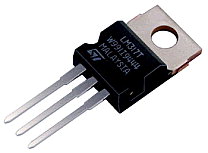
MATERIALS:-LM 317
Resistor

Veriable resistor

Ciramic capasitor

Circuit diagram

PROBLEMS
WHILE MAKING-1)I not place a resostor for the veriable resistor for
that veriable resistor is burn fully .soo i change the veriable resistor
but with that i place a resistor of 1K.
2)Due to unavaibleity of ciramic capasitor i not use ciramic capasitor.so it give me a huge problem while making.
OBSERVATION-The LM317T is an adjustable 3-terminal positive voltage regulator capable of supplying different DC voltage outputs other than the fixed voltage power supply of +5 or +12 volts, or as a variable output voltage from a few volts up to some maximum value all with currents of about 1.5 amperes. The voltage across the feedback resistor R1 is a constant 1.25V reference voltage, Vrefproduced between the “output” and “adjustment” terminal. The adjustment terminal current is a constant current of 100uA. Since the reference voltage across resistor R1 is constant, a constant current i will flow through the other resistor R2, resulting in an output voltage of:

Then whatever current flows through resistor R1 also flows through resistor R2 (ignoring the very small adjustment terminal current), with the sum of the voltage drops across R1 and R2 being equal to the output voltage, Vout. Obviously the input voltage, Vin must be at least 2.5 volts greater than the required output voltage to power the regulator.
Disadvantages of the LM317T regulator
One
of the main disadvantages of using the LM317T as part of a variable
voltage power supply circuit to regulate a voltage is that as much as
2.5 volts is dropped or lost as heat across the regulator. So for
example, if the required output voltage is to be +9 volts, then the
input voltage will need to be as much as 12 volts or more if the output
voltage is to remain stable under maximum load conditions. This voltage
drop across the regulator is called “dropout”. Also due to this dropout
voltage some form of heatsinking is required to keep the regulator cool.
Fortunately
low dropout variable voltage regulators are available such as the
National Semiconductor “LM2941T” Low Dropout variable voltage regulator
which has a low dropout voltage of just 0.9 volts at maximum load. This
low dropout comes at a cost as this device is only capable of delivering
1.0 amp with a variable voltage output from 5 to 20 volts. However, we
can use this device to give an output voltage of about 11.1V, just a
little lower than the input voltage.


Comments
Post a Comment