PRACTICAL ON CALORIE IN OUR BODY
INTRODUCTION
Calories are units of energy. Various definitions exist but fall into two broad categories.
- The small
calorie or gram calorie (symbol: cal) is the approximate amount of
energy needed to raise the temperature of one gram of water by one
degree Celsius at a pressure of one atmosphere.
- The large
calorie or kilogram calorie (symbol: Cal), also known as the food
calorie and similar names, is defined in terms of the kilogram rather
than the gram. It is equal to 1000 small
calories or 1 kilocalorie (symbol: kcal).
Although these units relate to
the metric system all forms of the calorie were deemed obsolete in
science after the SI system was adopted in the 1950s. The unit of energy
in the International System of Units is the joule. One small calorie is
approximately 4.2 joules (so one large calorie is about
4.2 kilojoules). The factor used to convert calories to joules at a
given temperature is numerically equivalent to the specific heat
capacity of water expressed in joules per kelvin per gram or per
kilogram. The precise conversion factor depends on the definition
adopted.
In
spite of its non-official status, the large calorie is still widely
used as a unit of food energy. The small calorie is also often used for
measurements in chemistry, although the amounts involved are typically
recorded in kilocalories.The
calorie was first defined by Nicolas Clément in 1824 as a unit
of heat energy, and entered French and English dictionaries between 1841
and 1867. The word comes from Latin calor meaning "heat".
DEFINATION
The
energy needed to increase the temperature of a given mass of water by
1 °C depends on the atmospheric pressure and the starting temperature.
Accordingly, several different precise definitions of the calorie have
been used.
Because energy is defined via work, the SI unit for energy is
the same as the unit of work – the joule (J), named in honor of James
Prescott Joule and his experiments on the mechanical equivalent of heat.
In slightly more fundamental terms, 1 joule is equal to 1 newton
metre and, in terms of SI base units
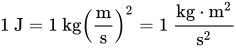
An
energy unit that is used in atomic physics, particle physics and high
energy physics is the electronvolt (eV). One eV is equivalent
to 1.60217653×10⁻¹⁹ J.
In spectroscopy the unit cm−1 = 0.000123986 eV is used to represent energy since energy is inversely proportional to wavelength from the equation .

In
discussions of energy production and consumption, the units barrel of
oil equivalent and ton of oil equivalent are often used.
When discussing amounts of energy released in explosions or bolide impact events, the TNT equivalent unit is often used.
FORMULAE FOR MAN AND WOMEN TO FIND CALORIE
Male-[13.75xweight]+[5xheight]-[6.076xAge]+66
Female-[9.56xweight]+[1.85xheight]-[4.68xAge]=655
ABOUT MY DAILY NEEDS OF CALORIE
=[13.75x74]+[5x163.75]-[6.076x17]+66
=[1017.5]+[818.75]-[103.292]+66
=[1732.958]+66
=1795.958
=1796 calorie
SO,
NOW I NEED 1796 CALORIE DAILY.
NOW I NEED 1796 CALORIE DAILY.


Comments
Post a Comment